
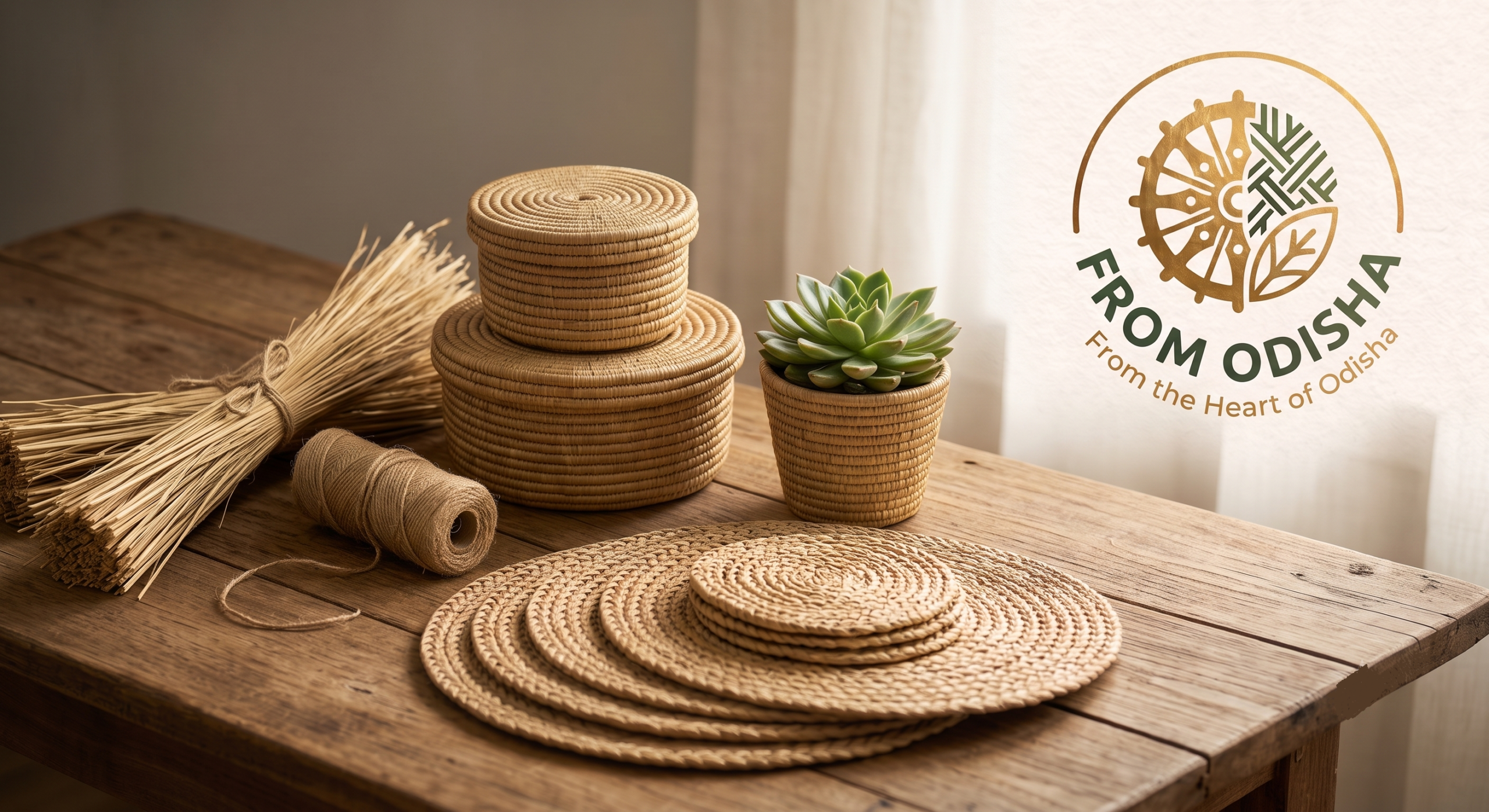
Sabai grass craft is one of Odisha’s quietest design traditions: a resilient wild grass, transformed by hand into useful objects for contemporary homes.
In the red-soil landscapes of northern Odisha, especially around Mayurbhanj, a perennial grass known locally as Bubei Ghasa grows across rain-fed and rocky ground. Its botanical name is Eulaliopsis binata, but the material is better known across craft communities as Sabai grass.
For generations, Sabai was twisted into strong ropes and used for everyday work. Today, the same natural fibre is being shaped into baskets, mats, planters, trays, and other home accessories. Each piece brings together local material knowledge, patient handwork, and a more considered approach to living with the things we use.
What makes Sabai grass special?
Sabai grass is valued for its strength, flexibility, and warm natural colour. Once dried and prepared, its long fibres can be twisted into cord and coiled or woven into structured forms.
- Strong and flexible: tightly twisted Sabai cord can create durable baskets and utility products without losing its natural texture.
- Low-impact by nature: the grass grows in terrain where many food crops are difficult to cultivate and needs comparatively little intervention.
- Biodegradable: unlike plastic storage and synthetic décor, untreated grass fibre can return to the natural cycle at the end of its useful life.
- Distinctive texture: its golden-beige surface brings warmth to minimalist, contemporary, and traditional interiors.
This combination of usefulness and visual simplicity is why Sabai grass craft feels at home in modern spaces. It is not a material that needs to disguise its origins. The visible coil, braid, and variation in tone are part of its character.
From grass to a finished Sabai product
A finished basket or mat may look simple, but it is the result of several stages of careful preparation. Depending on the product, the transformation can take several days of hand-guided work.
1. Harvesting and sun-curing
After the grass is harvested, it is cleaned and softened before being spread out to dry. Sun-curing reduces moisture and changes the fresh green blades into the pale golden fibre associated with Sabai craft. Drying needs attention to weather and handling so that the material is ready to be twisted without becoming brittle.
2. Twisting the cord
The dried blades are twisted by hand or with simple pedal-operated spinning equipment to create continuous cord. The density and consistency of the twist affect the strength and appearance of the final piece. This cord, sometimes called bana in local craft practice, becomes the basic building material for many Sabai products.
3. Adding colour
The natural golden finish is timeless, but Sabai can also be dyed for contemporary collections. Earthy ochres, indigo-inspired blues, and forest greens complement the fibre’s organic surface. Where colour is used, responsible makers should favour dyes and processes appropriate to the product’s intended use.
4. Coiling, braiding, and weaving
Artisans shape the cord into the required form, building it row by row with hand-coiling, braiding, or weaving. Cotton thread or other supporting fibres may be used to hold the structure together. Larger planters, hampers, and storage pieces can also be formed around a simple frame so that they retain their shape during everyday use.
The women behind the weave
Sabai grass craft is also a story about livelihoods. Women’s self-help groups and artisan producer communities have helped make home-based craft work more organised and accessible in rural Odisha.
For many artisans, the ability to work with a locally available material creates an income stream that can fit around family and seasonal responsibilities. When craft is supported with fair payment, dependable orders, design development, and direct market access, it can strengthen household livelihoods while keeping knowledge within the community.
A Sabai basket is therefore more than a decorative object. Its texture carries the work of harvesting, preparing, twisting, and shaping a natural material by hand. Supporting authentic craft means recognising both the object and the people whose skill makes it possible.
How to use Sabai grass in your home
Sabai works especially well where storage and decoration overlap. Its natural surface adds depth without making a room feel crowded.
- Storage baskets: use them for throws, books, toys, laundry, or the small everyday objects that gather on open shelves.
- Dining mats and trivets: bring a tactile, earthy layer to a dining table while helping protect its surface from warm dishes.
- Planter baskets: place a terracotta or ceramic nursery pot inside a Sabai holder to add natural texture to an indoor garden.
- Wall groupings: arrange shallow baskets or trays in different sizes to create a soft, handcrafted focal point above a sofa or bed.
How to care for Sabai grass craft
Natural fibre products are easy to live with when they are kept dry and handled gently.
- Keep Sabai products in a dry, well-ventilated area.
- Dust regularly with a soft brush or dry cloth.
- For a small spill, wipe promptly with a lightly damp cloth and mild soap, then allow the product to dry fully.
- During humid weather, give the item time in indirect sunlight and fresh air if it has absorbed moisture.
- Do not soak, machine-wash, or place woven Sabai products in a dishwasher.
A living craft from Mayurbhanj
Sabai grass shows how sustainability can begin with attention to place. A material that once served a practical purpose as rope can become a considered part of modern home life without losing its connection to the landscape where it grows.
At FromOdisha, we are interested in the complete story behind regional craft: the material, the process, the maker, and the community that carries the tradition forward. This is part of our wider commitment to making Odisha’s living heritage more visible and connecting people with products whose origins can be understood.
Frequently Asked Questions
What is Sabai grass?
Sabai grass is a natural perennial grass, commonly identified as Eulaliopsis binata and known locally in Odisha as Bubei Ghasa. Its dried fibre is twisted into cord and used for craft products.
Where does Sabai grass craft come from?
Sabai grass craft is associated with several parts of eastern India. In Odisha, Mayurbhanj is an important region in the story of the material and the artisan communities who work with it.
Is Sabai grass biodegradable?
Untreated Sabai grass is a plant-based natural fibre and is biodegradable. The full end-of-life impact also depends on other materials used in the product, such as frames, threads, coatings, or dyes.
How should Sabai grass products be cleaned?
Dust them with a soft brush or dry cloth. For a small spill, use a lightly damp cloth with mild soap and let the product dry completely. Avoid soaking or machine-washing.
From a wild grass in Mayurbhanj to a hand-shaped basket in a contemporary home, Sabai craft is a reminder that good design can be durable, useful, and rooted in the living heritage of a place.